Was Huxley right?
Mar. 29th, 2020 09:40 pm![[personal profile]](https://www.dreamwidth.org/img/silk/identity/user.png) nairiporter
nairiporter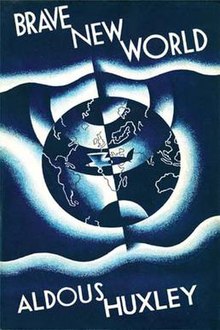
We needn't look too far in the sci fi books to find a good dystopia. We might actually already be living in one. In 1931, nearly a century ago, Brave New World was published by one Aldous Huxley. A story of a hypothetical future of a homogeneous, complacent, docile consumerist society whose members constantly consume new stuff and then throw it away, the populace regularly dopes itself with antidepressants to be happy, they are being told that having society split into castes and classes is perfectly normal, and everyone is constantly being occupied in all sorts of meaningless forms of labour so they don't have enough spare time to think and ask questions.
Sure, I'm not the first one to ask the question if we don't already live in that brave new world, or at least in something that strikingly resembles it. The writer himself published an essay about 3 decades after that book, commenting that the real world was pacing toward his dystopia more quickly than he had ever expected. He believed one of the main reasons was overpopulation, and the resulting methods of population control. He ended his essay with some hints about how the democracies of the day could avoid devolving into totalitarian societies.
The regimes of the future, he argued, will be ones where the dictators rule over "free slaves" who genuinely love their slavery.
The economy of Huxley's World State is based on the principles of mass production and mass consumerism. The people (not citizens, but rather users) have access to all sorts of goods, and they are stimulated to consume more and more, and dispose of their old stuff, buying new things every day.
The purpose of all this is to keep people constantly occupied with work, production and consumption, so they have no remaining time to think, and ask questions or ponder if there isn't something that is off with their society. They are being distracted with music, television, entertainment, even something resembling virtual reality that allows them to "feel" what the actors are doing on screen.
To guarantee a sense of happiness, society is constantly pumped with an antidepressant called "soma", and everyone is being hypnotised into believing the notion that "everything is just as it was supposed to be". The Divide and Rule principle is replaced with the Make Them Buy And Stay Silent principle. And those who dare to speak up are being isolated and carefully monitored.
But the similarities to real persons and events do not end there. Huxley brave new world is built around the principles of Henry Ford's production line: mass production, homogeneity, predictability, and ceaseless consumption. The one difference is that religion seems to be dead in that society, and all irrational belief in the supernatural; instead, Ford himself is viewed as the creator of that society, and revered almost as a god.
Today, Silicon Valley is a place of semi-mythical superhuman visionaries with a painfully huge ego selling dreams, friendships, and a bright new future. With a new brand and new wrapping every next year, and with every next model.
Surprisingly for Huxley, religion is still a factor today. I'm sure many of the 20 century sci fi authors would be perplexed to learn this. Or maybe not: while religion is a source of comfort for some, for others it's still being primarily an excuse for violence, aggression, and dominance.
Maybe this difference from Huxley's brave new world comes from the fact that despite two world wars, our world still hasn't seen a full-scale global conflict with biological and chemical weapons capable of exterminating entire nations, which is what brought the dystopian society in the book. Unlike the United Government that rules the World State in the book, today our world is more divided than it has been in many decades. World leaders are openly questioning the usefulness of the UN and the existing alliances, and we are witnessing bewildering scenes of friendship and exchange of cordial smiles and hugs between murderous dictators and the leader of the free world.
The old alliances and partnerships are corroding before our eyes, facing their own incapability of dealing with old and well forgotten challenges such as migration.
Diversity is being officially praised and encouraged, at times to a point where the inclusion of the marginalised minorities gives rise to a fierce reaction, resulting in more racism, homophobia, others sorts of phobia, and ultimately, hatred and division, than the last century has seen.
The comparisons could go on and on. Page after page from the book, and year after year from our millennium. It is clear that we must have come closer to Huxley's dystopian "brave new world" rather than departed from it.
The question we ought to be asking ourselves is, which is now more frightening, the evil fantasy that the author prophesised almost a century ago, or the very reality that we now inhabit.


